Product links on this page go to Amazon. If you buy through them, Your First Radio earns a commission. How we pick and earn
A first ham radio is almost always a handheld, and the choice runs from a radio that costs less than the exam fee to one that costs more than the mobile you’ll buy next. Here’s what the numbers mean and what to pick.
Bands
Every handheld on our ham radio page is dual-band: 2 metres (144–148 MHz) and 70 centimetres (420–450 MHz), the two bands a Technician uses for repeaters and local simplex. Some add receive-only coverage of airband, weather and FM broadcast, which is a nice-to-have for listening. There is no reason to buy a single-band handheld as a first radio.
Power
Five watts is the handheld norm, and the difference between 4 and 7 watts is smaller than it looks: a doubling of power is one S-unit at the far end, and nobody hears that on FM. What changes range is the antenna and your height above ground. The Baofeng’s 4-or-5 watts, the Yaesu’s 5 and the BTECH’s “7 peak” will all hit the same repeaters from the same spot.
Batteries and charging
Battery capacity is where the cheap and the mid-range radios actually differ: 1,500–1,800 mAh on a stock UV-5R, 1,950 on the Yaesu, 2,600 on the UV-PRO, 3,100 on the AnyTone. A radio spends most of its time receiving, and Yaesu publishes its runtime on a 5/5/90 duty cycle: 5 seconds transmitting, 5 receiving, 90 standby, which is honest about how radios are used.
Charging matters more than capacity. A radio that charges from USB-C charges from the same power bank as your phone, in the car, in a shelter. A radio that needs its cradle needs its cradle. The BTECH UV-PRO and the AnyTone charge over USB-C; the Yaesu and the stock Baofeng use a cradle, and a USB-C battery pack fixes the Baofeng.
Analog or digital
Analog FM is what every repeater speaks and what you’ll use on day one. DMR adds clearer audio, talkgroups that link repeaters worldwide, and an evening building a “codeplug” in Windows software before the radio does anything. If your local club runs a DMR repeater, the AnyTone AT-D878UVII Plus is the standard choice; if you don’t know, start with FM.
Certification, and the Baofeng question
A ham radio that transmits only on ham frequencies needs no FCC certification at all. One that can transmit outside them must be certified, and in 2018 the FCC issued an enforcement advisory (DA 18-980) aimed at exactly the cheap dual-band handhelds that tune 136–174 and 400–520 MHz and are sold without one. The radios are still sold; the obligation to transmit only where your licence allows is yours.
None of the ham handhelds here is certified for GMRS or FRS. The UV-PRO’s maker says so in writing; the others simply aren’t. A ham licence plus a ham radio gets you the ham bands, and nothing in the menu changes that.
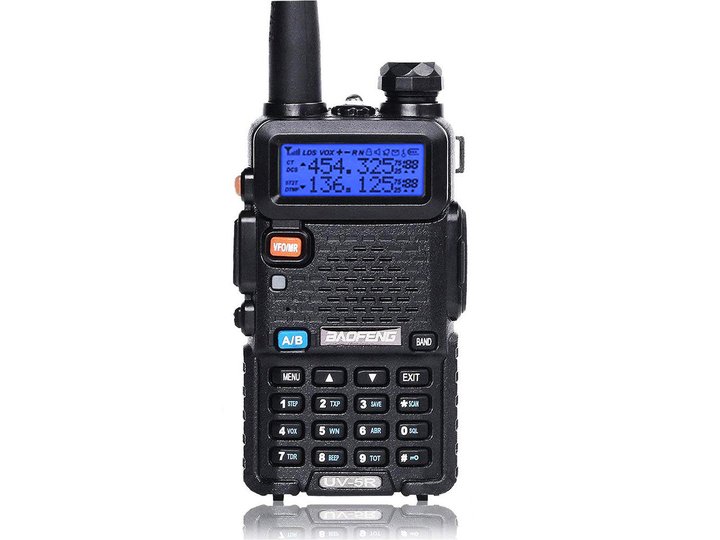
Budget dual-band handheld
Baofeng UV-5R
Baofeng UV-5R
The handheld most new hams start on: 2 m and 70 cm FM, 128 channels, a desk cradle, and a price that makes it a study aid rather than a commitment. Programmed from a computer with CHIRP and a cable.
- Bands
- 136–174 / 400–520 MHz (ham use: 2 m, 70 cm)
- Power
- 4–5 W / 1 W (maker figures differ)
- Channels
- 128
- Battery
- 7.4 V, 1,500–1,800 mAh Li-ion
- Charging
- Desk cradle
- Certification
- Amateur use; not Part 95 (no GMRS/FRS)
Suits: Studying for the Technician and listening to the local repeater before the licence arrives. Buy it, learn on it, and decide later whether you want a better one.
Weigh: It transmits far outside the ham bands, which is on you to avoid, and its receiver is easily overloaded near strong signals. Baofeng and BTECH publish different power (4 W vs 5 W) and battery figures (1,500 to 1,800 mAh) for the same radio, so treat both as approximate. Not certified for GMRS or FRS. The "8W" listings under this name are a different radio sold as a bundle.
The antenna upgrade
The stock antenna on a budget handheld is a compromise, and the first thing experienced hams change. The Nagoya NA-771 is the standard replacement and the most counterfeited antenna in the hobby; buy it from the listing that names BTECH. In a car, a magnet mount on the roof does more than any handheld upgrade.
The three mistakes
Buying power. The 8-watt bundles sold under the UV-5R name are a different radio with a bigger battery and a tactical antenna, and they reach the same repeaters.
Buying the programming cable with the wrong chip. The cheap cables use a counterfeit chip and need the driver workaround every forum describes. The BTECH FTDI cable works the first time.
Skipping the licence. The radio is legal to own and to listen on. Transmitting without the licence is the one thing that gets a beginner a letter. The exam takes an evening of study.
Which one
- Learn on it, maybe keep it: Baofeng UV-5R, with the FTDI cable and the NA-771.
- Keep it: Yaesu FT-65R.
- GPS, APRS, USB-C, phone setup: BTECH UV-PRO.
- The club runs DMR: AnyTone AT-D878UVII Plus, or the Radioddity GD-88 to try it for less.
Then read repeaters and antennas for the first week on the air.