Product links on this page go to Amazon. If you buy through them, Your First Radio earns a commission. How we pick and earn
The Technician licence is the entry to amateur radio in the US, and it is easier than its reputation. Every question you can be asked is published in advance. Here is the whole process, with the rule that backs each step.
The exam
The Technician exam is Element 2: 35 questions, and you pass with 26 correct (47 CFR 97.503). The questions are drawn from a public pool: the 2026–2030 Technician pool, effective July 1, 2026 through June 30, 2030, has 409 questions in ten sections, and your 35 come from it. Study the pool and you have seen the exam.
There’s no Morse code, and there hasn’t been since 2007.
Before exam day: an FRN
The FCC identifies you by an FCC Registration Number, and you need one before the session. Register in the FCC’s CORES system, which costs nothing and takes a few minutes; the ARRL’s exam-finder page says plainly that you are required to have an FRN before exam day. Bring it.
Where to take it
Exams are given by volunteer examiners under one of 14 FCC-appointed coordinators. Two routes:
- In person, at a club meeting or a hamfest, usually a weekend morning. The ARRL and W5YI exam finders list sessions by ZIP code.
- Remote, by video, most days of the week. GLAARG has run most of its exams online since 2020 and charges $10, waived for students and veterans. You need a webcam, a quiet room, and an empty desk.
The fee and the wait
After you pass, the examiners file your application and the FCC emails you to pay a $35 application fee (47 CFR 1.1102), which has applied since April 2022. You have ten days from the email to pay or the application is dismissed. A few days after payment, your callsign appears in the FCC database and you are licensed for ten years (47 CFR 97.25).
You can transmit as soon as the callsign is in the database, not before.
What a Technician can do
The licence covers every amateur band above 50 MHz with full privileges, which is where the handheld and mobile radios live: 2 metres (144–148 MHz) and 70 centimetres (420–450 MHz) (47 CFR 97.301). That means local repeaters, simplex with friends, APRS, DMR, satellites and most of what a new ham does. HF, the long-distance bands, come with the General exam, which is the next step and uses the same format.
What it doesn’t cover
A ham licence doesn’t make a ham radio legal on GMRS, FRS or MURS. Those are separate services with separate rules, and they require certified radios (47 CFR 95.335). If the goal is family radios in a storm, that’s the GMRS guide, and the licence there needs no exam.
The order that works
- Order a radio. The Baofeng UV-5R costs less than the fee; the Yaesu FT-65R is the one you keep.
- Program the repeaters in your area and listen.
- Study the pool for a week or two with a practice-exam site.
- Get the FRN, book a remote session, pass.
- Pay the $35 within ten days.
- Key up on the repeater you have been listening to and say your callsign.
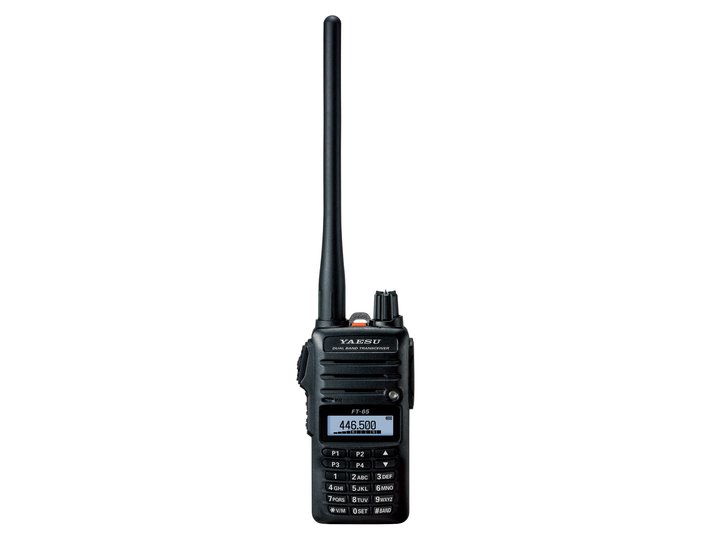
Dual-band handheld from a ham maker
Yaesu FT-65R
Yaesu FT-65R
A plain, tough 5-watt dual-band handheld from one of the three big amateur makers: 1,950 mAh battery, a loud 1 W speaker, IP54 splash rating, weather alert, and a three-year warranty.
- Power
- 5 / 2.5 / 0.5 W
- Battery
- 1,950 mAh SBR-25LI, 3.5 h rapid cradle
- Audio
- 1 W speaker
- Rating
- IP54; 2.1 × 4.1 × 1.2 in (listing)
- Extras
- Weather alert, FM broadcast receive
- Warranty
- 3 years
Suits: The first "real" handheld: a beginner who wants a radio built for the ham bands by a company that will still answer the phone in three years.
Weigh: No USB charging, only the cradle; 200 memories; keypad programming is slow, and the SCU-59 programming cable is a separate purchase. Yaesu does not publish the transmit range on its page.