Product links on this page go to Amazon. If you buy through them, Your First Radio earns a commission. How we pick and earn
Nothing in radio needs a licence to receive, and a month of listening teaches more than any book. Two ways to do it, at very different prices.
The SDR dongle
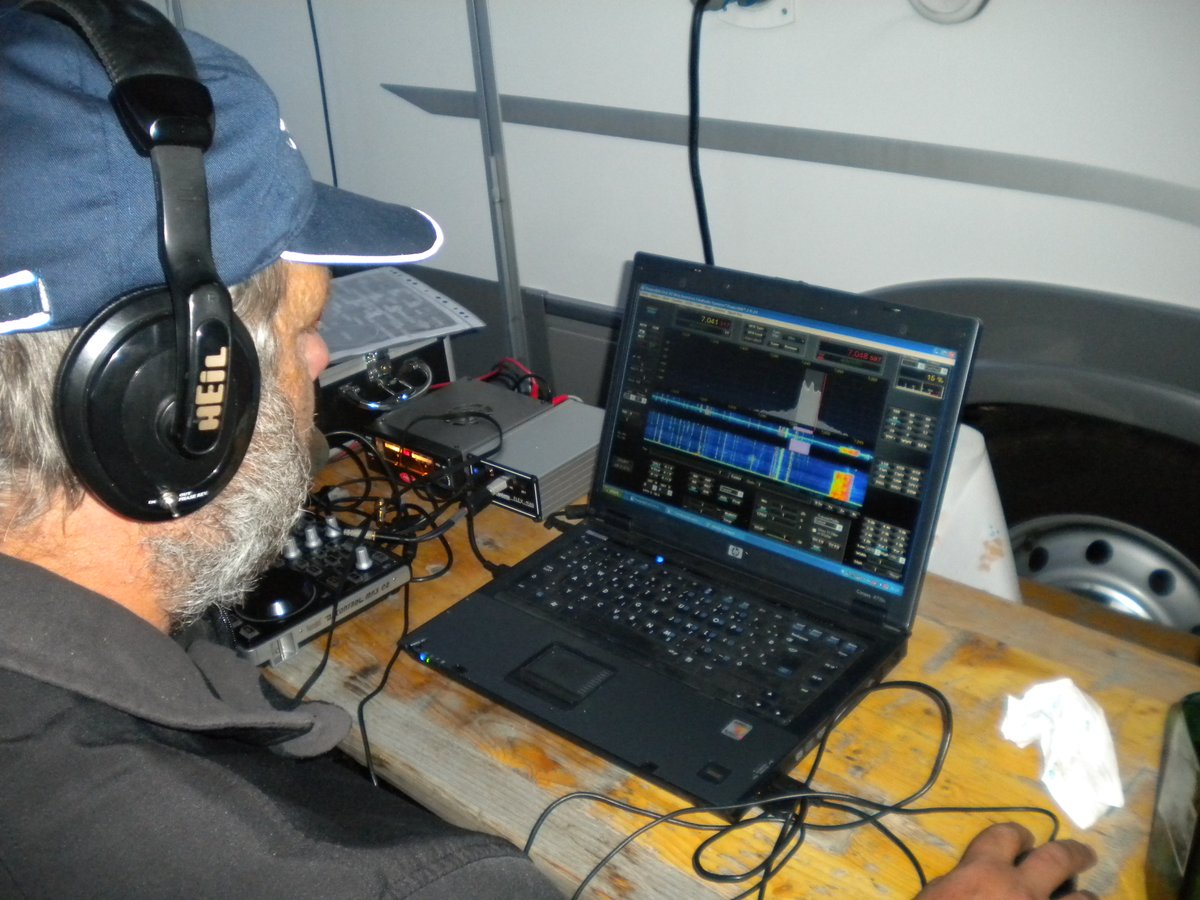
A software-defined radio is a USB stick that hands the raw radio spectrum to your computer, and open-source software (SDR# on Windows, GQRX or CubicSDR on Mac and Linux, SDR++ on all three) tunes and decodes it. The RTL-SDR Blog V3 covers 500 kHz to 1.7 GHz, which means AM and FM broadcast, the weather channels, the ham bands, aircraft, marine, and the analog public-safety and business frequencies, all on a waterfall display that shows you where the signals are.
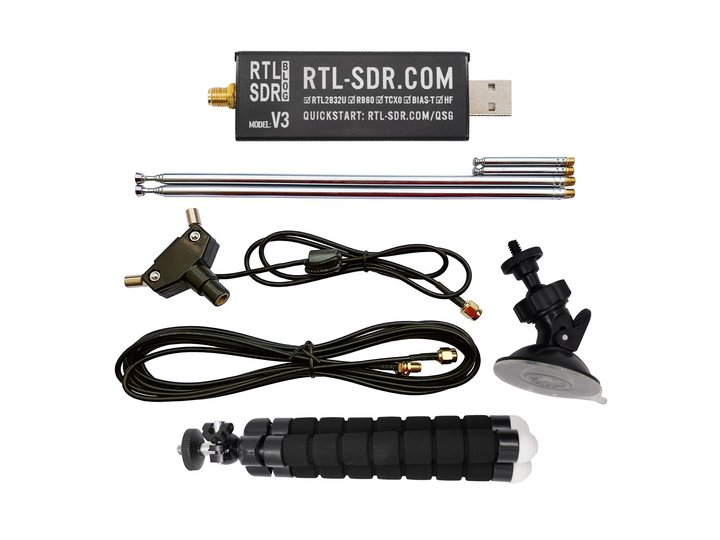
The maker’s dipole kit matters: the bare dongle has no antenna worth using, and the kit’s telescoping dipole on a window suction mount hears the local repeaters and the airport.
Software-defined radio receiver, USB
RTL-SDR Blog V3 with dipole kit
RTL-SDR Blog V3 + dipole antenna kit
The USB stick that turns a laptop into a receiver from 500 kHz to 1.7 GHz: hear the ham bands, weather, aircraft, and what the scanner crowd hears, with open-source software. This kit adds the maker's dipole antenna set, which is the part the bare dongle lacks.
- Range
- 500 kHz–1.7 GHz (listing)
- Bandwidth
- 3.2 MHz (2.4 MHz stable)
- Tuner
- R820T2, 1 PPM TCXO
- Connector
- SMA-female; bias tee
- In the box
- Dipole antenna kit
Suits: Listening before you can transmit: the week between ordering a radio and passing the exam, and anyone curious what is on the air.
Weigh: Receive only. The newer V4 isn't sold on Amazon under the maker's name (the "V4" listings there are clones); the V3 is the genuine one. HF reception on the V3 uses a direct-sampling mode that is a step down from the V4's.
What it can’t do out of the box is follow a digital trunked radio system, which is what most police and fire departments use. There are open-source tools (DSD+, SDRTrunk) that make a pair of dongles do it, and that’s a project rather than a purchase.
The scanner
A scanner is a purpose-built receiver that follows trunked systems: it watches the control channel and jumps to whichever voice channel your chosen talkgroup is on, decoding the digital voice. The question is which digital mode your county uses:
- P25 (Phase I or II): most large public-safety systems. The Uniden BCD325P2 handles it; the SDS100 handles the simulcast systems that garble on cheaper scanners.
- DMR and NXDN: many smaller counties and most businesses. The Whistler TRX-1 decodes both out of the box; the Unidens need paid upgrades.
Look up your county on RadioReference before buying anything. It lists every system, its mode, and whether it’s encrypted, which no scanner can hear.
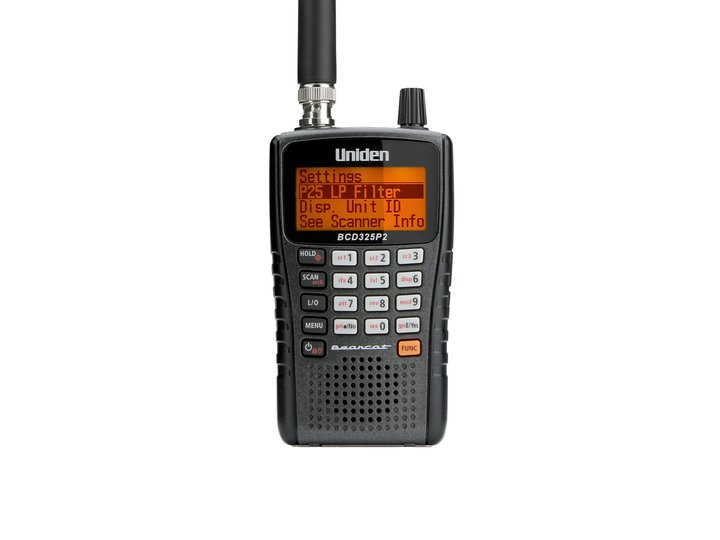
Handheld digital scanner, P25
Uniden BCD325P2 scanner
Uniden BCD325P2
A handheld scanner that follows the digital trunked systems most US police and fire departments use (P25 Phase I and II, Motorola, EDACS, LTR), with 25,000 channels and Close Call, which tunes to whatever is transmitting nearby.
- Digital
- P25 Phase I/II; Motorola, EDACS, LTR trunking
- Channels
- 25,000
- Features
- Close Call, S.A.M.E. weather, GPS-based scanning
- Not decoded
- DMR, NXDN
- Weight
- 16 oz (listing)
Suits: Listening to local public safety where the system is P25 or analog; check RadioReference for your county first.
Weigh: No DMR or NXDN, which some counties and most businesses use. Uniden doesn't publish the frequency coverage or battery details on its page; the listing says 16 oz. Programming a trunked system is real work.
Which one
- Curious, or studying for the ham exam: the SDR kit. Hear the repeaters you’ll be using, watch the weather channel, find the airport.
- Local police and fire: a scanner matched to your county’s mode.
- Both: the SDR first; it tells you what’s there.
Two cautions. Some states restrict scanners in vehicles; check yours. And a ham or GMRS radio that “scans” is a scanner only for analog FM; the digital systems need a real one.
When listening turns into wanting to talk, the Technician licence is the next step.