Product links on this page go to Amazon. If you buy through them, Your First Radio earns a commission. How we pick and earn
Walk into the radio aisle, or search for “two way radio”, and you’ll find six different things with different rules, sold side by side. Here is each one in a paragraph, with the licence it needs and the rule that says so.
The short table
| You want to | Service | Licence | First radio |
|---|---|---|---|
| Talk to family in a storm, across town | GMRS | $35, no exam, 10 years, whole family | Midland GXT67 Pro |
| Join the hobby: repeaters, nets, a callsign | Ham (amateur) | 35-question exam, $35, 10 years | Yaesu FT-65R |
| Walkie-talkies for a trip | FRS | None | Motorola T470 |
| Range through woods, no licence | MURS | None | BTECH MURS-V2 |
| Hear the road from a truck | CB | None | Uniden PRO510XL |
| Warnings that wake the house | NOAA weather radio | None (receive only) | Midland WR120B |
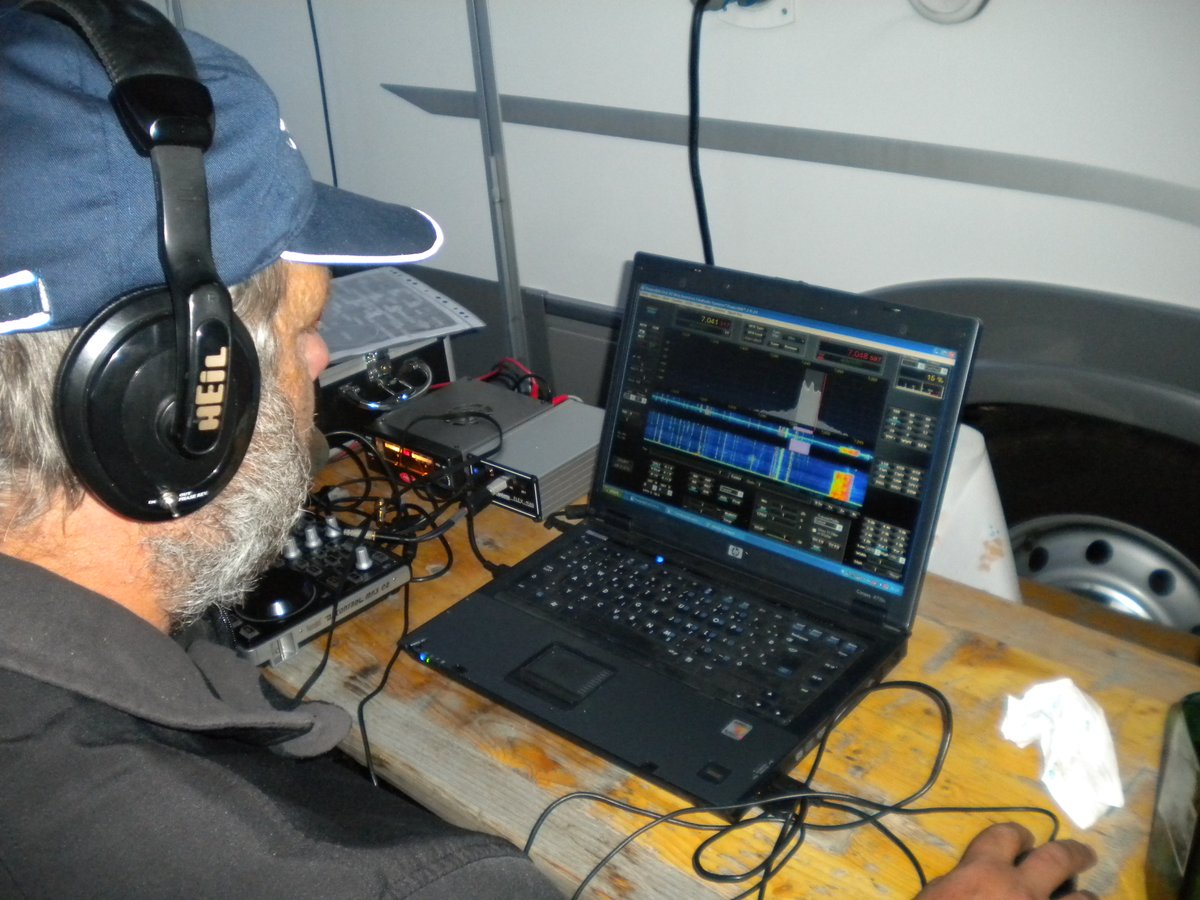
| Listen to everything | SDR or scanner | None (receive only) | RTL-SDR V3 kit |
FRS: the walkie-talkies
The Family Radio Service is 22 UHF channels shared with GMRS (47 CFR 95.563), no licence (95.305), 2 watts on channels 1–7 and 15–22 and half a watt on 8–14 (95.567), and an antenna that must be a fixed part of the radio (95.587). That fixed antenna is why FRS reaches a mile or two whatever the box says: every maker’s “35 miles” footnotes to about two in a neighbourhood. For a campground, a cruise ship or a pair of kids, that’s enough.
GMRS: the family service
The General Mobile Radio Service uses the same 22 channels plus eight repeater inputs (95.1763), with removable antennas, 50 watts for mobiles and bases, and repeaters. One licence costs $35, needs no exam, lasts ten years and covers the licensee’s spouse, children, parents, siblings and in-laws (95.1705). It is the right answer for a household that wants to stay in touch when the cell network goes down. The radios must be certified for GMRS (95.1761); a ham radio with GMRS channels in its menu isn’t one. The GMRS guide has the rest.
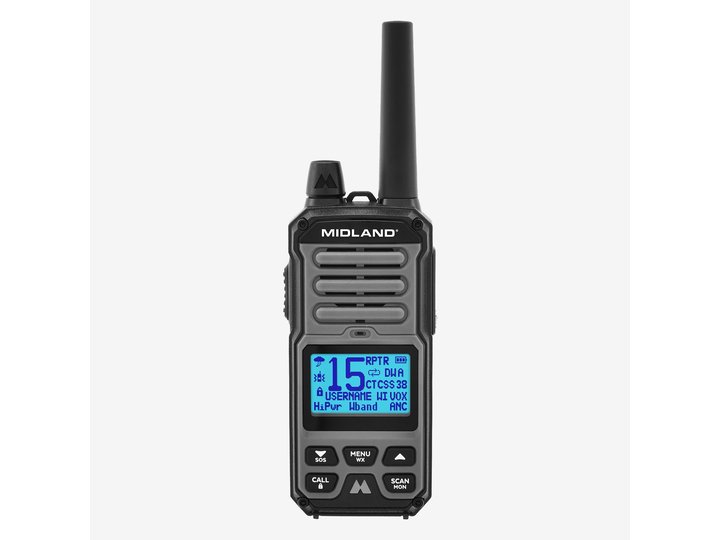
5 W GMRS handheld, repeater capable
Midland GXT67 Pro
Midland GXT67 Pro
Midland's current GMRS handheld: 5 watts, the 22 standard channels plus 8 repeater channels, an IP67 case, NOAA weather alerts and USB-C charging, built to be handed to someone who has never used a radio.
- Power
- 5 W
- Channels
- 22 GMRS/FRS + 8 repeater
- Rating
- IP67
- Charging
- USB-C compatible, about 4 h
- Weather
- NOAA alert
- Weight
- 9.6 oz (listing)
Suits: The family radio: a parent, a teenager, a hunting partner, a hurricane kit.
Weigh: Midland doesn't publish the battery capacity or the certification number on the product page. No Bluetooth or app; programming the repeater tones takes a separate cable or the keypad.
Ham radio: the hobby
The Amateur Radio Service is the one with the exam: 35 questions from a published pool, 26 to pass (97.503), a $35 fee, ten years (97.25). It opens the 2 m and 70 cm bands (97.301) and much more, with repeaters, digital modes, satellites and a worldwide community. It’s a hobby and a public-service corps, and it’s the right answer if you want to learn radio rather than just use one. The Technician guide walks through the exam.
A ham licence doesn’t make a ham radio legal on GMRS, FRS or MURS: those need certified radios (95.335), and ham radios aren’t.
MURS: VHF with no licence
The Multi-Use Radio Service is five VHF channels around 151 and 154 MHz (95.2763), 2 watts (95.2767), no licence. VHF carries better through woods and over hills than the UHF walkie-talkies, so MURS suits a farm or a trail crew. Only five channels, and MURS radios only talk to MURS radios.
CB: the road
Citizens Band is 40 channels at 27 MHz (95.963), no licence, 4 watts on AM or FM and 12 watts peak on single sideband (95.967). It’s the truckers’ band and the overlanders’ band, it needs a tuned antenna, and on a good day the ionosphere carries it across the country. A compact 40-channel unit or a handheld with a mobile adapter is the start.
NOAA weather radio: the one everyone should own
Receive only, no licence. The National Weather Service broadcasts on seven frequencies between 162.400 and 162.550 MHz from more than a thousand transmitters. A SAME-equipped alert radio, programmed with your county, stays silent until there’s a warning for you, then sounds a siren and reads it. Ready.gov puts one in the basic emergency kit. A plug-in alert radio for the house and a crank radio for the kit.
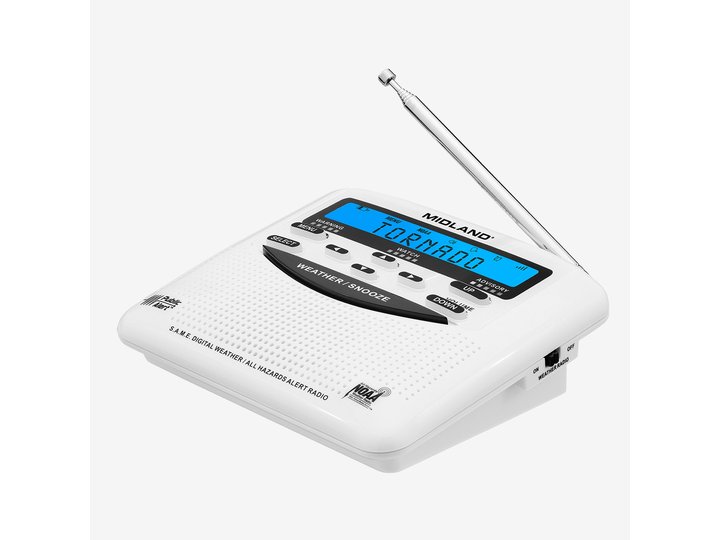
NOAA weather radio with SAME alerts
Midland WR120B weather alert radio
Midland WR120B
The weather radio for the kitchen counter: it sits silent until the National Weather Service issues a warning for your county, then sounds a 90 dB siren and reads the warning. Programs up to 25 counties, runs on AC with three AAs as backup, Public Alert certified.
- Alerts
- S.A.M.E., up to 25 counties
- Siren
- 90 dB
- Power
- AC; 3 × AA backup (not included)
- Certification
- Public Alert
Suits: Every household in tornado or hurricane country. Ready.gov lists one in the basic kit.
Weigh: Midland's page says both "over 60" and "85+" alert types. The AAs are backup only and aren't included. No AM/FM.
Scanners and SDR: listening
No licence to listen. A USB SDR dongle and open-source software turn a laptop into a receiver from the AM broadcast band to 1.7 GHz; a handheld scanner follows the digital trunked systems public safety uses. Look your county up on RadioReference first to see which digital mode it’s on.
What a cheap dual-band handheld is
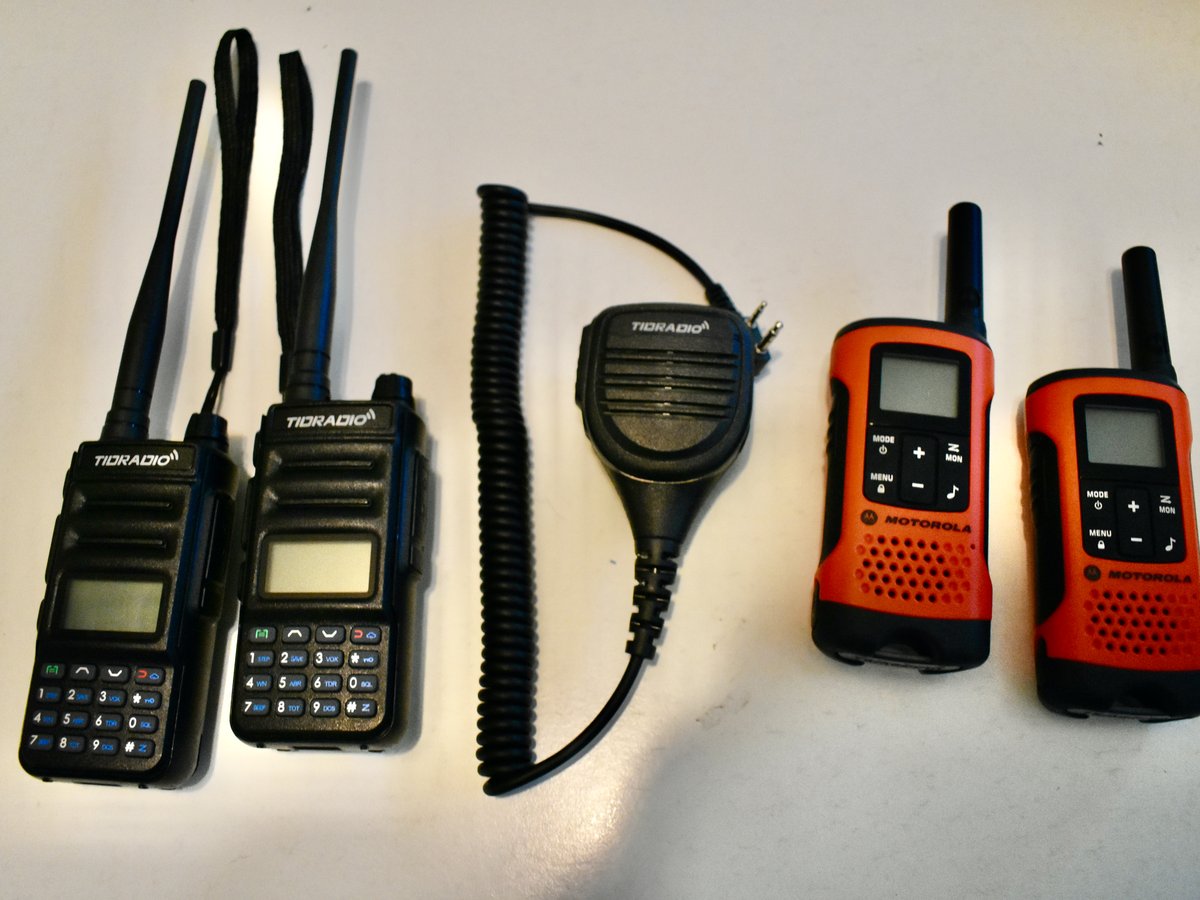
The cheap dual-band handheld that tunes 136–174 and 400–520 MHz can transmit on ham, GMRS, FRS, MURS, marine and public-safety frequencies. With a ham licence it’s legal on the ham bands. On everything else it isn’t, because it’s not certified for those services (95.335), and the FCC’s 2018 advisory on exactly these radios is still in force. It’s a fine first ham radio and the wrong answer to every other row of the table.
Pick your row: ham, GMRS or personal radio.